Decoding the Equation: What to Keep in Mind for Net RevPAR and Cost of Sales & Distribution
This article aim to draw the list of sales & distribution costs you may want to consider for your propertie(s) in order to calculate your NetRevPAR. They are categorized by the most common way to approach them. The list is not exhaustive and certainly not “written in stone”. The secondary goal is a to share challenges and solutions around these costs approach.
Why am I sharing these thoughts? Well, what is great with working for Profit Intelligence is that I am dealing with totally different hotels and organization types and sizes every day. One of our modules that raises most of the interest is our CIA (Cost Intel Analytics):
In few words, we take the PMS(s) and/or CRS data and we calculate tailor made costs at reservation level. With these costs, we design actionable dashboards for hotels to take the right strategic decisions on their Cost of sales & distribution with the goal to increase their NetRevPAR and profitability overall.
For each client onboarding, the main and most crucial phase of the project is to define which costs types the hotel(s)/organizations want to calculate. But since every hotel is unique….my conclusion (so far 😊 ) is: there is no one size fit all answer!
I try to share here an honest experience which I hope will bring some reflection on that subject.
Spoiler alert: don’t expect to see here any OTA, hotel or tech partners names!
Let’s start from the most “obvious” cost categories:
Commissions cost:
Can very per day of week, per hotel/brand etc…% commission is quite easy and simple to calculate for most of the usual OTA.
The fun starts when a channel generates 2 types of bookings: commissionable and net (markup). how can we differentiate them? The solution always lies in the data: do you have different profiles? Or do you use specific rate codes? Ultimately, can we assume that virtual credit card payments are markup when other payments are commissionnable?
Of course, GDS travel agent commission should be in as well…usually only on public and consortia rates. (Not on corporate rates but it can happen)
What about group bookings? For hotels where groups and M&E represent a big share in their mix, the commission on group business is an important factor that must be calculated! So yes, if you want to compare apples with apples let’s inject costs based on group rooms revenues but also M&E revenues.
Markup cost
For OTA or Wholesalers with contracted % markup, that’s easy: same as for commission category, just apply the calculation rule. (Per day of week, per hotel/brand etc…)
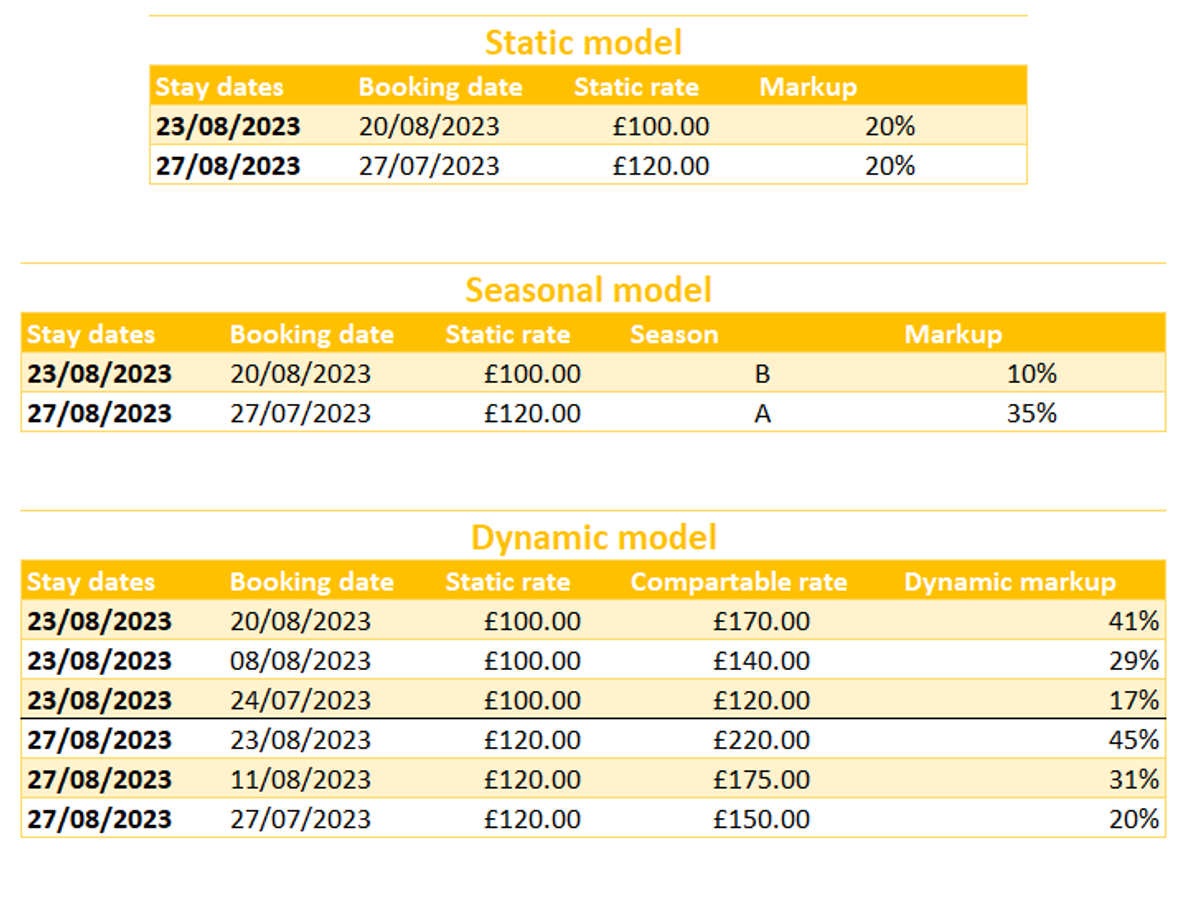
However, for hotels working with FIT static model…what to anticipate as markup? Example: you sold your Room including BB and city tax at 100$. But how much markup the wholesaler applied? What was the final rate to the guest? Yes, all wholesalers will tell you that the room rate was packaged… 😉but there is always a final markup applied on their side.
The quickest solution would be to apply a fixed markup value: for example, you could estimate that on average the wholesalers apply 20% markup on static rates(fix model). Going further you can apply a variable markup based on market demand: i.e buzzy days the wholesalers can sell your room at +35% when lows demand days would be +10% only(seasonal model) . An ultimate markup anticipation would be to compare the static rate with a comparable public rate at the same booking date (dynamic model). For this exercise, you can use your rate shopper data to find out your comparable public rate.
Below tables present you the 3 model variables:
Markup and P&L impact: the difficulty with markups? This line doesn’t exist in hotels’ P&L… Yielding practices on the “guest booked rate” (rather than the “system rate” like 99% of hotels do) has no direct and readable impacts on the hotels P&L. It only has a positive impact on the profitability results when good “guest booked rate” yielding practice are in place.
CRS/channel manager/ reservation cost:
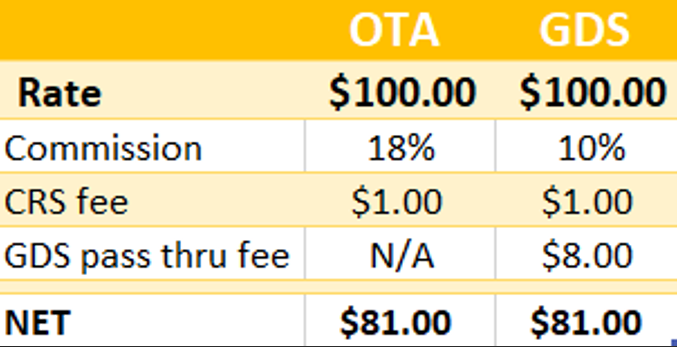
Is an important cost often underestimated. Input here the cost that is charged by your CRS or channel manager provider. Not to forget: the GDS pass thru fee! (By the way, did you know that GDS pass thru fee is still applicable even on no show?)
Better than words, the below table demonstrates that despite a lower commission, the GDS bookings can be as expensive as an OTA one when you integrate a fixed pass thru fee factor:
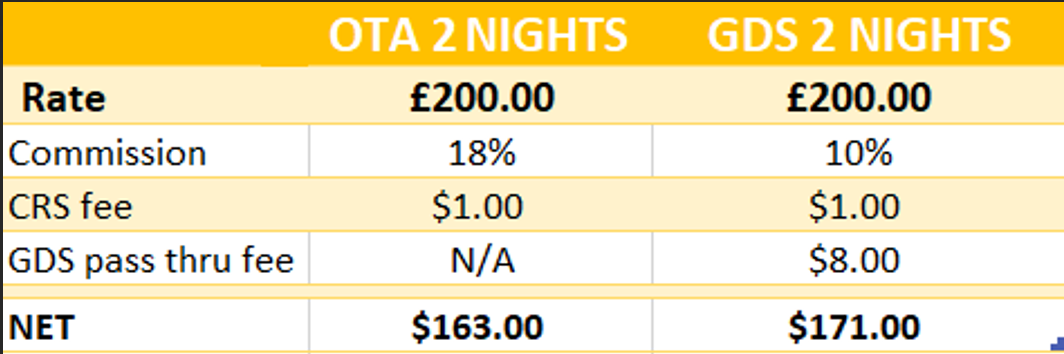
When you have a fix fee per reservation, the length of stay of the booking plays an important role: longer the stay is, better it is since the fix fee is diluted. In the below table, since the GDS pass thru fee apply once for the entire stay, the GDS booking is more profitable.
Payment cost
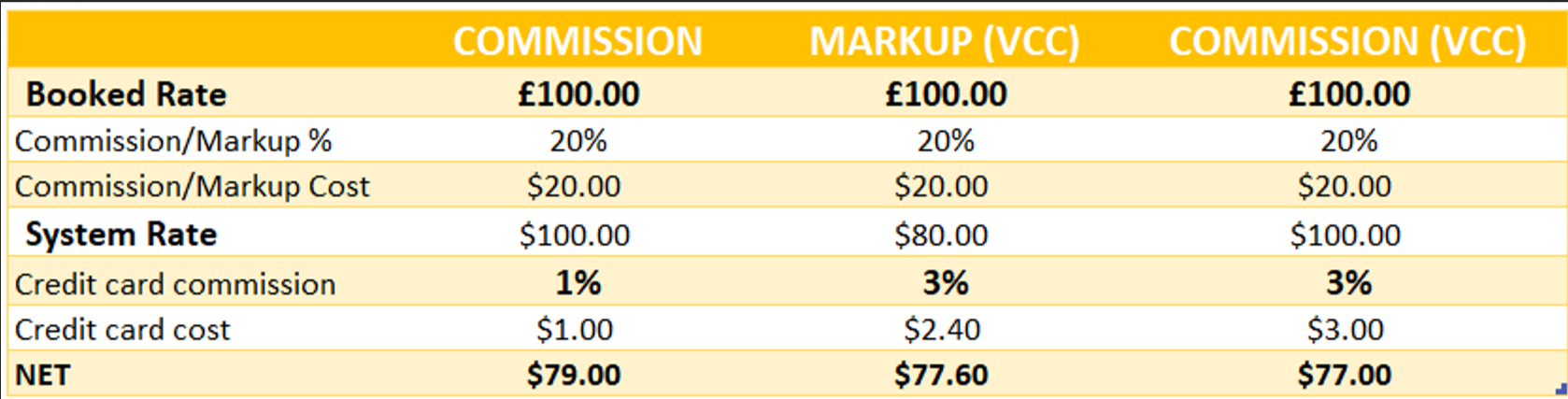
Often forgotten as well but % fee on the credit card can be quite consequential. Depending on the type of card that is charged the ratio can vary from 0.5% to more than 3% of the booking or stay value!
VCC (Virtual Credit Card) are often way more expensive than a guest credit card. This needs to be put into the balance. VCC are most of the time used to charge net rates (commission/markup is already deducted). So, on a same given “guest booked rate” their costs can be minored. The worst scenario is a VCC on a commissionable rate…
Also, depending on channel, it can be more or less “painful” to reconcile payments: if your receptionists or accountants are spending 5 min per reservation to reconcile payments….that’s an effect on productivity and at the end on the “cost of the channel”.
Here as well, do not underestimate the “power of groups”. A group with a rooming list and one payment made on invoice can be more profitable than a group with the same rate but where all guests pay individually with their credit card. (nor to forget the “operational cost” is different as well: one group check in & checkout versus individual check in/checkouts… but that’s a productivity topic 😊)
FTE costs
On FTE they are no “one size fit all” answer. Each hotel or organisation is unique (that’s the beauty of the hotel industry isn’t it!) and setup of the costs type must be done “à la carte”.
Here are some random questions to define how to attribute FTE costs:
Revenue management team: is usually working for “all channels & market segment” à his/her cost would be then divided by the number of bookings or room nights without any distinction?
Sales team: usually have roles and contribution defined per market segment. Are they contributing to corporate individuals? M&E & group bookings? FIT ? leisure groups….? You may then attribute the FTE sales cost per dedicated market segment.
Reservation team: same here, make sure to allocate the right market segments and/or channels.
Marketing team: work only to contribute to your brand.com and direct business? Well, they often take care of the overall image of the property. Contents must be updated on all channels including OTA 😉.
What about central team working for multiple hotel? In such case, you may need to define cost allocation per property. Depending on the hotel type and size you should be able to define which hotels are benefiting the more or the less from the efforts of each position. The results of this reflection can look like this:
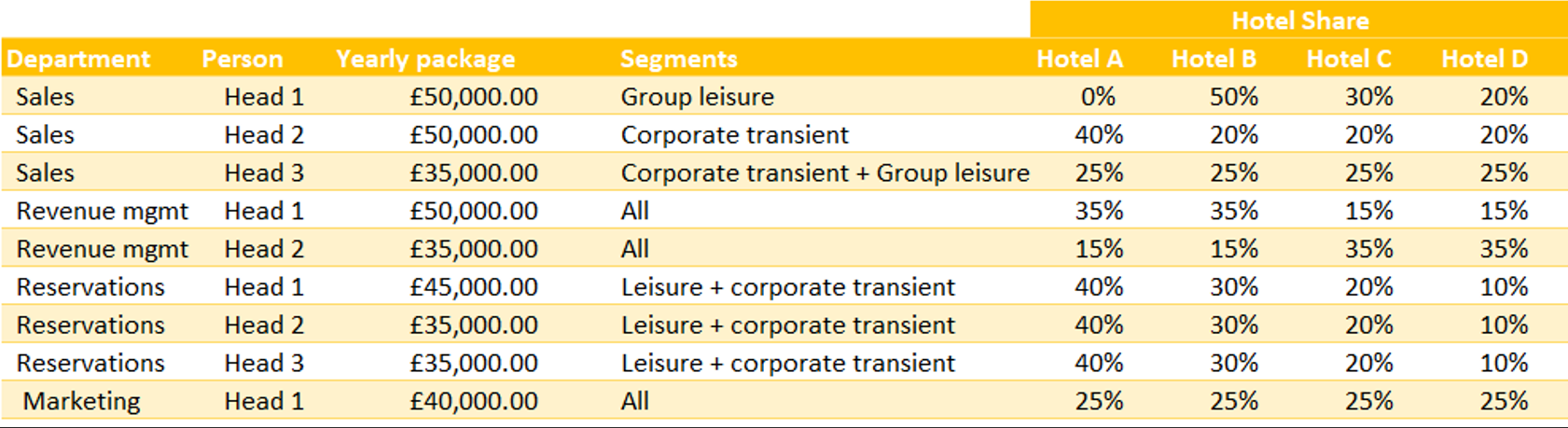
Sales & marketing cost
Here as well, they are no “one size fit all” answer. The key point here is to list and track the S&M actions whatever they happen locally (hotel level) or globally (hotel group level). Then you may ask yourself 2 questions:
- Which segments/channels are targeted?
- When are the effects taking place?
If you spend 10K for a leisure agency roadshow, make sure this cost goes to leisure groups segment. If this action has estimated outcomes mainly for summer season, allocate the cost only to these stay months.
If you run a marketing action to boost reservations for your region of 10 hotels, make sure to split the cost +- to the different hotels equitably. You usually attribute a higher cost contribution to the hotel(s) that will benefit the most of the campaign; (hotel 1 – 10%, hotel 2 -20% – hotel 3 -5%…etc ). If this action has estimated outcomes mainly for the next 2 months, allocate the cost only to the next 60 days booking dates.
For internet paid search or metasearch campaign, the options will vary as per the model which is used: % commission per reservation? a fixed budget amount to allocate : XXXX€/month for direct web business?
Partner and/or system(s) cost
When they are used to their right potential, systems are an important part of your cost of Sales & Distribution efficiency. They allow automation, communication facilitation, deep analysis and at the end of the day should increase your productivity and coverage.
But they are not coming for free. Whatever you are using tools for CRM, email automation, meta&paid search management, market business intelligence, RFP management, RMS…etc it is recommended to list these systems and related costs. Once done, here as well allocate the costs to the right channels or segments. Example: RFP management tool cost would usually be allocated to corporate segment(s).
Last but not least, the hotel tech landscape has recently seen the rise of systems built on a transactional remuneration model. For example, some PMS now charge fees based on the payment volumes processed through their integrated partners.
Concretely, it can mean a 2% fee on the total transaction volume. It’s up to you to decide whether this falls under your “system costs” or “payment costs” category — but with such a direct impact on your P&L, make sure it’s properly tracked and accounted for
Loyalty Cost
I may here admit a limit when it comes to loyalty costs: whatever calculations you put in place, it would never draw you the full picture of the program efficiency. Above all, loyalty programs help hotels to build long-term relationships with their guests, increase brand loyalty, and generate repeat business. Cost figures only won’t show you all of this benefits.
But from a financial perspective, loyalty programs involve costs such as program development, marketing, and rewards or incentives for members.
You may insert related loyalty related costs and allocate these costs to the appropriate channels/segments. Often, only the costs linked to the points attribution is counted. (i.e. 10000 point would be charged X€ for the reservation to the hotel).
What is recommended is to also inject the earnings/spent from the loyalty points: i.e. 3% of my turnover is generated from guests redeeming their points to my property for high season/ 5% in low season.
The “loss” and the “gain” must be balanced and would represent the “cost” of the program. Sometime you may see positive figures: the balance goes more toward the earning and your loyalty program bring you money (in the strict sense of earnings) .
Is the % discount I give to all members a cost? The answer is no! If you start to count discounts as cost, then you must list of the discounted rate plans and attribute a cost to all these rate plans; Would you say that your public 10% discounted rate for length of stay 2 nights has a 10% cost?
Other costs
As stated earlier on this article, there is no one size fit all answer about costs or sales & distribution. In bulk but not limited to, below are costs you may consider entering:
Commission override: if you periodically increase commission level to buy visibility and reach a larger audience. Would you categorize commission override as marketing cost or directly in commission?
Franchisee and/or management fees: up to your appreciation and would also depend on the contract details with your franchisor. Make sure you are not doubling the costs with other ones. (Example; distribution fees are often included the CRS fees).
CO2 equivalent: let’s take it to another angle and calculate the cost…. for our planet! With the help of professionals of the matter, once the calculation rules are clearly defined, nothing prevent to calculate this measure!
Conclusion:
If you arrived at these lines you might think “it’s freaking complex!”. And the truth is that yes, it can turn to be complex. And I spared you challenges such as “how to consolidate multicurrency hotels when some fee are invoiced in a single currency?” 😊
I found this quote on LinkedIn. It pictures well the situation:
Total Profit Management is like teenage sex: everyone talks about it, nobody really knows how to do it, everyone thinks everyone else is doing it, so everyone claims they are doing it.
Plenty of data and results can be populated but the true question is: what will you concretely do with it? Does the effort worst it? To my mind, there are “low hanging fruits” that can be easily grabbed before investing in NetRevPAR management to increase profitability. For example: an accurate arrival & departure forecast to manage Housekeeping and Front Desk staffing planning efficiently? Most of revenue manager are looking at their segment pickups based on room revenue… why not starting to yield based on Total Revenue?
Building your costs structure is like building a house. You may not install solar panels to produce electricity if you will use this electricity to heat badly isolated walls…. you better invest in good isolation 1st!
What do I want to achieve and what are the resources needed to complete this achievement? Here are the 2 right questions to ask before looking at which costs type you want to calculate.
If your primary goal is to benchmark properties S&M costs efficiency, then you may enter a maximum of costs type: but make sure that comparisons are done “apples to apples”.
If the goal is to yield rate plans, you may need to start with commission/markup and distribution costs. In such case, ensure that you have the necessary resources to implement strategical yielding actions: i.e let’s close/limit these rate plans for these channels for these days…are you technically able to do it with your channel manager? If your Revenue Management System allows it, you may also want the cost data to be transferred and used by the algorithm? (By the way, there is still some work here on the RMS side 😉)
What about adopting and implement new KPIs and practices? Are you ready to forecast on the net revenue base?
In the hotel industry, global standards are almost nonexistent. The most recognized is USALI — but its scope is purely accounting. When it comes to measuring commercial profitability performance, no such standard exists.
Take NetRevPAR for example: is there a universally accepted definition? The answer is no. But does it matter? My view — no.— because what truly counts is how well your chosen definitions align with the goals your organization sets for itself.